Eligible U.S. ordinary-passport holders can use China’s 240-hour visa-free transit policy when the itinerary and entry conditions qualify. The central route requirement is transit from one country or region, through China, to a different country or region. A short U.S.–China–U.S. round trip does not qualify simply because it lasts less than ten days.
Check the actual flight sequence, the permitted ports and areas, your passport and the confirmed onward journey before deciding that you can travel without a visa.
Start with the route: A → China → B
Think of the country or region immediately before mainland China as A and the next one after mainland China as B. They must be different for the transit route test. The relevant journey is not always the first and last city printed on a long booking.
| Illustrative routing | Transit route test |
|---|---|
| United States → Shanghai → Japan | Different country before and after China; potentially suitable, subject to all other conditions. |
| United States → Beijing → United States | Same country before and after; not a qualifying 240-hour transit route. |
| Japan → Shanghai → Japan | Same issue, even if the cities in Japan differ. |
| A longer itinerary with a connection outside China | Examine the actual adjacent countries or regions, not just the overall start and finish. |
These examples explain only the routing principle. They do not establish eligibility for a particular ticket, entry port or stay plan.
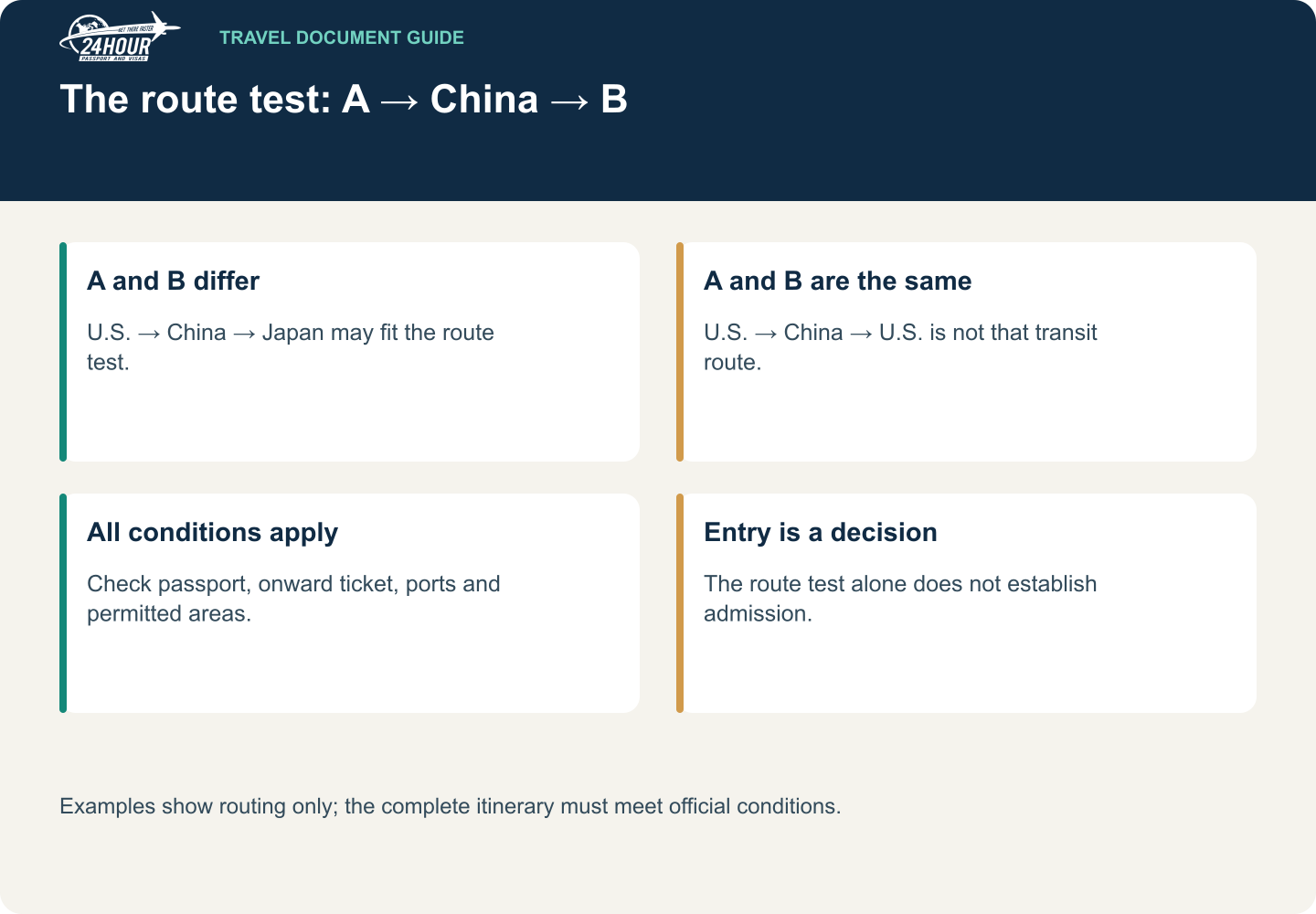
Read this graphic as text
- A and B differ: U.S. → China → Japan may fit the route test.
- A and B are the same: U.S. → China → U.S. is not that transit route.
- All conditions apply: Check passport, onward ticket, ports and permitted areas.
- Entry is a decision: The route test alone does not establish admission.
Examples show routing only; the complete itinerary must meet official conditions.
Check the other conditions as a complete set
The National Immigration Administration’s visa-free transit policy lists the United States among eligible nationalities and requires an ordinary passport, confirmed onward travel and use of designated ports and permitted areas. It also distinguishes activities allowed during the visit from work, study or news reporting that require appropriate prior authorization.
- Nationality and passport: use an eligible ordinary passport with at least three months of remaining validity, and meet the next destination’s entry requirements.
- Confirmed onward journey: have the ticket and departure details, not merely an intention to buy them after arrival.
- Entry and exit ports: check the current designated-port list for the route you booked.
- Places you will visit: stay within the areas authorized by the policy and your entry permission.
- Time limit: use the period and deadline determined under the official entry procedure.
- Purpose: an allowed short visit is different from employment or study requiring other permission.
A cheaper connection can change the country immediately before or after China. Reassess the route if an airline schedule change alters that sequence.
Do not treat “240 hours” as an automatic ten-night booking
The Shanghai government’s transit explanation says the 240-hour period starts at 00:00 on the day after arrival. For example, an arrival on May 1 starts that clock at the beginning of May 2. Use China local time and the actual deadline granted by immigration, not the time zone on your home calendar.
The same official explanation lists at least three months of passport validity and confirmed onward travel. That transit-specific passport condition is different from a consulate’s passport requirement for a normal visa application.
Leave a practical buffer for a delayed flight or a disrupted connection. If the itinerary depends on using the very last permitted hour, a small schedule change can become a document problem.
How is 24-hour transit different?
The 24-hour transit policy has different conditions and is not simply the first day of the 240-hour policy. Staying within a port’s restricted area is also different from permission to pass immigration and leave the airport. A traveler needing to leave that area must obtain the relevant temporary entry permission.
If the trip does not fit an exemption, the appropriate visa route may be needed. A G transit visa is a visa application; it is not the same thing as a visa-free transit permission granted at arrival.
What to carry and confirm before departure
Keep the onward reservation, planned accommodation details and relevant itinerary information accessible. Confirm document requirements with the operating airline for the full routing and use official Chinese immigration information to resolve eligibility questions.
An airline carrying you to China and immigration admitting you are separate decisions. Neither an online arrival card nor a travel agency’s route suggestion guarantees admission.
When a visa may be the more suitable plan
If you want a straightforward round trip, a longer visit, a route outside the permitted arrangements or activities requiring a visa, plan the correct application rather than reshaping the facts to resemble transit. Our China visa guide explains the main categories and application route.
Frequently asked questions
Does a return ticket to the United States qualify?
Not when the route immediately before and after China is the United States. Duration alone does not make it transit.
Can I freely travel anywhere in China during the stop?
No. The policy has designated ports and permitted stay areas. Check the places in your actual itinerary.
Can a private service issue the transit permission?
No. Chinese authorities determine entry permission. If you need a visa instead, ask 24 Hour Passport & Visas about application assistance before departure.
Tell us your destination, departure date and application status. Call first to arrange a visit to our Los Angeles office.
Call (310) 913-7804