Wear normal, comfortable clothing for a U.S. passport photo, keep your full face visible and remove eyeglasses unless an official medical exception applies. A simple top that contrasts with the white or off-white background is a practical choice. There is no requirement to wear formal business clothes or a particular color.
Which clothing advice is a rule—and which is just a useful choice?
Use the official appearance requirements to distinguish restrictions from styling suggestions. Do not replace one outfit with another because an app invents a color rule. Use this distinction when deciding what actually needs changing.
| Your choice | How to assess it | Practical next step |
|---|---|---|
| A plain navy or black everyday top | A practical contrast choice, not a required government color. | Check the face, background and lighting; the top alone does not make a photo compliant. |
| A white everyday top | White clothing is not automatically prohibited. It can blend into a light background. | Use a darker top if the outline is hard to see; do not digitally recolor the shirt. |
| A uniform or camouflage garment | The official clothing restriction applies. | Change into ordinary clothing before the photo. |
| Ordinary eyeglasses | Removal is a requirement unless the documented medical exception applies. | Bring a glasses case; arrange any exception evidence before the appointment. |
| A religious or medical head covering | It is an exception with specific documentation and face-visibility requirements, not a decorative-hat rule. | Review the official instructions for the applicable covering; do not remove necessary items solely to imitate a sample image. |
The photograph should look like you on an ordinary day. Clothing is useful when it keeps attention on your face, rather than creating a reason to retake the photo.
Religious clothing worn daily has different treatment from an occupational uniform. Follow the official religious-attire instructions rather than assuming every uniform-like garment falls under the same rule.
Choose an everyday top with a clear neckline
A solid navy, dark green, burgundy or similar top can be easy to distinguish from the background. These are practical suggestions, not government-approved colors. White is not automatically prohibited, but it may blend into the background.
Avoid a style that makes you appear undressed after the photograph is framed around your head and shoulders. Bulky collars or scarves can also hide the jawline or create shadows.
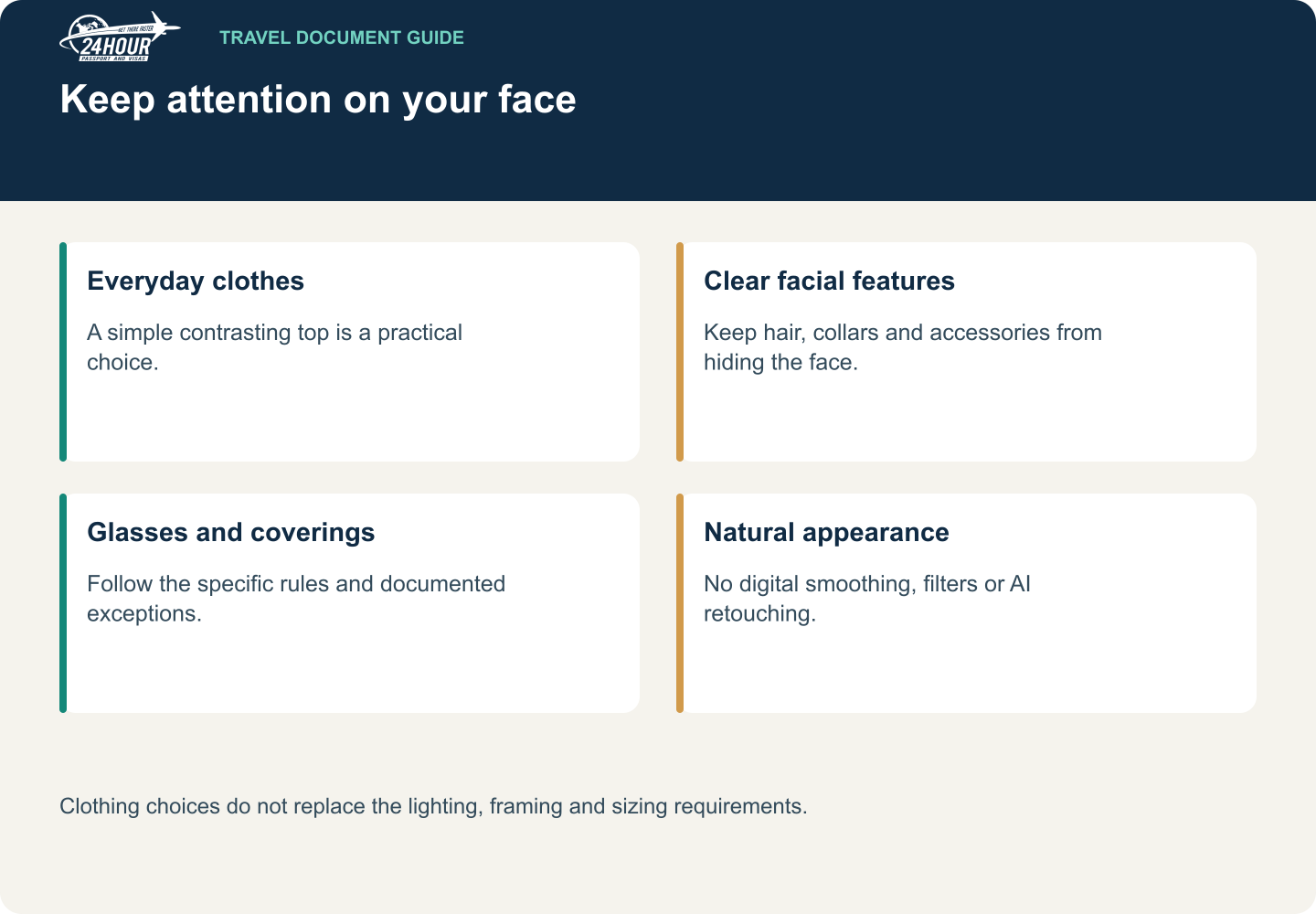
Read this graphic as text
- Everyday clothes: A simple contrasting top is a practical choice.
- Clear facial features: Keep hair, collars and accessories from hiding the face.
- Glasses and coverings: Follow the specific rules and documented exceptions.
- Natural appearance: No digital smoothing, filters or AI retouching.
Clothing choices do not replace the lighting, framing and sizing requirements.
Keep permitted coverings clear of your face
A permitted covering must not cast a shadow across the face. Do not ask a photographer to digitally remove fabric or a shadow; adjust the arrangement and take another photograph.
Hair, jewelry and makeup
Wear your hair so it does not obscure the eyes or other facial features. You do not need a special haircut. If fringe or loose hair falls across the face during the photo, move it naturally and retake the image.
Jewelry and facial piercings can remain when they do not hide the face. Large reflective accessories may make even lighting harder, so choose a simpler option if needed. Do not remove a piercing digitally.
Everyday makeup is a practical choice if you normally wear it. The photo must remain a natural, unaltered image. Beauty filters, skin smoothing and AI retouching are not solutions for a passport photograph.
Hearing aids and accessibility needs
Do not remove a hearing aid or another normally worn hearing device solely because you assume all devices are forbidden. Explain your needs to the photographer and review the government’s photo and disability guidance for your situation.
Headphones and unrelated electronic accessories should not appear. If positioning or a medical condition makes a standard setup difficult, resolve the appropriate procedure rather than forcing an unsafe or painful pose.
For camera position, print dimensions and lighting, use our at-home passport photo guide. This clothing checklist does not replace the sizing and image-quality requirements.
Try the outfit in the actual photo framing
Use a test image before the final session. A wide mirror view can hide the fact that a scarf reaches the jaw, a collar casts a shadow, or a low neckline disappears below the photo’s lower edge. Move the garment or change the outfit physically, then take a fresh photograph. Do not use digital clothing replacement.
Example: a white T-shirt against an off-white wall is not a rejection solely because both are light. If the photograph is evenly lit and the face is clear, check it against the complete official requirements. A dark T-shirt may be simpler to photograph, but changing the shirt cannot fix an unsuitable wall, blur or glasses.
The State Department’s Appearance and Pose and expression examples provide real photographic comparisons. Keep a neutral expression or a natural closed-mouth smile; avoid an exaggerated expression. For an infant or toddler, use the separate child-specific instructions rather than applying an adult appearance checklist unchanged.
Frequently asked questions
Can I wear black?
Yes, a normal black top can be a practical choice against the light background. It still needs to leave your face and neck area clear.
Can I smile?
A neutral expression or a natural smile is allowed. Keep your mouth closed and eyes open, without an exaggerated expression.
Does a U.S. passport photo work for a China visa?
Do not assume so. The dimensions and digital requirements differ. See our China visa photo specifications.
Need a photo taken professionally? Ask about 24 Hour Passport & Visas photo services and confirm arrangements before visiting.
Tell us your destination, departure date and application status. Call first to arrange a visit to our Los Angeles office.
Call (310) 913-7804